

Best AI Product Description Generator in 2026: Compared for eCommerce Teams
Best AI Product Description Generator in 2026: Compared for eCommerce Teams
The best AI product description generator for a solo Etsy seller and the best one for an eCommerce operations team managing 2,000 SKUs are not the same tool.
Target Australia generates over 1,000 complete product descriptions every week at 98% accuracy at first generation — not because they found a better prompt, but because they use a platform built for catalog operations, not one-off writing tasks.
This guide cuts through the noise and compares what actually matters: bulk generation, data enrichment, store connectivity, and brand consistency at scale.
Why Most Tool Comparisons Ask the Wrong Question
84% of eCommerce businesses rank AI as their top priority right now — but most tool comparison guides and “best AI product description generator” articles still evaluate AI generators on writing quality alone. They paste in a product name, run it through six tools, and score the output on tone and creativity.
That’s the wrong test for anyone running a real eCommerce catalog.
Writing quality matters — but it’s not the constraint. The constraint is: how do I generate accurate, on-brand descriptions for 500 products without spending a month on it? That’s a workflow problem. And writing quality is only one part of the workflow.
The right evaluation criteria for eCommerce teams:
- Bulk generation — can it process your entire catalog in one run, or only one product at a time?
- Data enrichment — can it fill gaps in sparse supplier data before generating?
- Store connectivity — does it connect to Shopify, WooCommerce, or your PIM and publish back without copy-pasting?
- Brand consistency — can you enforce tone, vocabulary, and structure across every SKU automatically?
- Pricing model — does it scale economically with your catalog, or does it penalise volume?
Evaluated on these criteria, the shortlist gets very short, very fast.
The Best AI Product Description Generators in 2026
1. Describely — Best for eCommerce Catalog Scale
Describely is purpose-built for eCommerce teams that need to generate and manage product content across large catalogs. It’s the only tool on this list that covers the full workflow: connect your store, enrich sparse product data, apply brand rules, bulk generate, and publish back — without leaving the platform.
What sets it apart: Data Enrichment — the ability to automatically fill missing product attributes from trusted web sources before generating descriptions. No other tool in this comparison does this. For retailers and distributors who receive incomplete supplier data, this is the difference between generating accurate descriptions and generating generic ones.
Content Rules let you define tone, vocabulary, structure, and required phrases once — and apply them automatically to every generation across your catalog. At ten products, you can manually edit for brand consistency. At a thousand, you need Content Rules.
The Shopify integration handles the full loop: import your catalog, generate content, review, and publish back in one click. WooCommerce, Wix, Squarespace, Akeneo, and CSV/XLSX import are also supported.
Pricing: Pay-as-you-go — $0.75 per product, $0.55 per enrichment credit, $0.05 per image credit. No subscription, no seat fees. Scales directly with your catalog rather than penalising growth.
Best for: eCommerce operators, retailers, and distributors managing 100+ SKUs who need accurate, on-brand descriptions at catalog scale.
Not ideal for: Solo sellers who need one or two descriptions occasionally — the workflow is built for volume.
2. Hypotenuse AI — Best for Batch Generation Without Deep Catalog Management
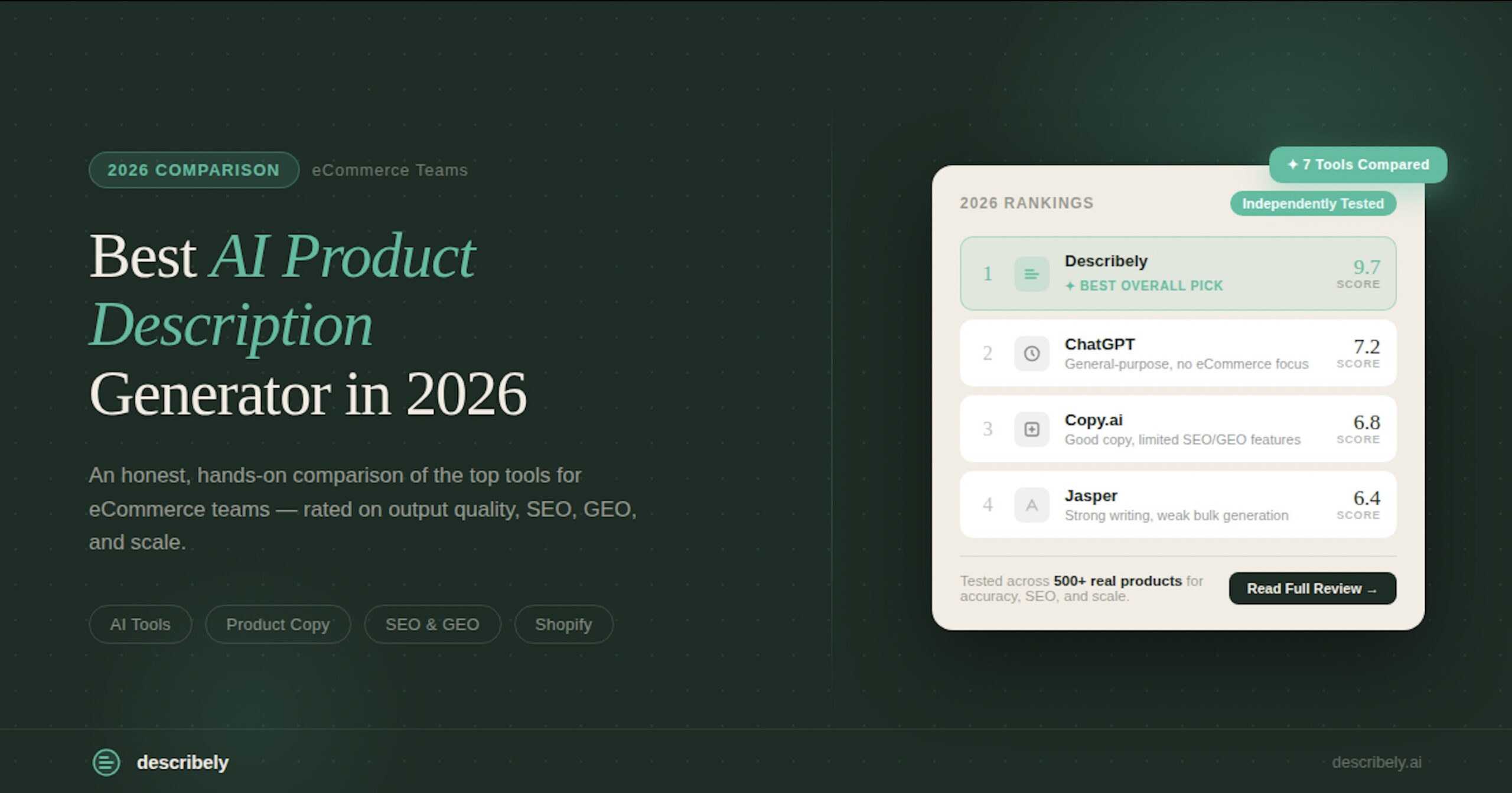
Hypotenuse AI is the closest competitor to Describely in terms of eCommerce focus. It supports batch content generation, has a product catalog feature, and produces solid output quality. For teams that need to generate descriptions in batches and have reasonably clean product data to start with, it’s a capable option.
Where it falls short at scale: no native data enrichment (sparse input data still produces sparse descriptions), limited store connectivity, and no equivalent of Content Rules for enforcing brand voice automatically across large runs. It operates on a subscription model, which means costs don’t scale down during low-volume periods.
Best for: Teams with clean product data who need batch generation without the full enrichment workflow.
3. Jasper — Best for Marketing Copy Teams
Jasper is a strong generalist AI writing platform with solid output for marketing copy: ads, emails, landing pages, and social content. It has a large template library and a polished interface that marketing teams adopt quickly.
For product descriptions specifically, Jasper works product-by-product. There’s no bulk generation for catalogs, no Shopify or WooCommerce connector, and no data enrichment. Teams that start using Jasper for product content typically hit a ceiling once their SKU count grows past a few hundred — at which point the manual per-product workflow becomes the bottleneck.
Best for: Marketing teams producing campaign copy, ads, and editorial content who occasionally need product descriptions.
Not ideal for: eCommerce operations teams with large product catalogs.
4. Copy.ai — Best for General Marketing Automation Workflows
Copy.ai has shifted toward marketing workflow automation — connecting AI writing to broader GTM processes. Its strength is embedding writing tasks into larger marketing workflows and automating repetitive content operations across teams.
For eCommerce product descriptions, Copy.ai’s product catalog management is limited. There’s no native Shopify or WooCommerce integration for two-way sync, no data enrichment, and no catalog-level brand rules. It can generate individual product descriptions competently but isn’t designed for catalog-scale operations.
Best for: Marketing operations teams that need AI writing embedded into broader workflow automation.
Not ideal for: eCommerce teams who need catalog import, enrichment, and store publishing in one platform.
5. Writesonic — Best for Content Teams on a Budget
Writesonic is a broad-purpose AI writing tool covering blog posts, ads, landing pages, and product descriptions. It’s one of the more affordable options with a generous free tier, making it accessible for small teams and solo operators.
For product descriptions at catalog scale, Writesonic’s limitations match Jasper and Copy.ai: no catalog management, no store connectors, no enrichment, and no bulk generation for large product sets. It’s a capable writing tool for individual descriptions, not a catalog operations platform.
Best for: Solo operators and small teams who need occasional product descriptions alongside other content types.
6. Shopify Magic — Best for Getting Started on Shopify
Shopify Magic is included in all Shopify plans at no additional cost. For a new store with a handful of products, it generates a usable description from a product title in seconds — right inside the Shopify admin.
The ceiling is low. Shopify Magic generates one product at a time, with no bulk capability, no data enrichment, and no Content Rules. Every generation starts fresh with no memory of your brand voice. For stores managing hundreds or thousands of products, it’s a starting point that quickly becomes a bottleneck.
Best for: New Shopify stores with small catalogs who want a free, frictionless starting point.
Not ideal for: Any catalog larger than 50–100 products where consistency and speed matter.
7. ChatGPT — Best for One-Off Descriptions with Good Prompting
ChatGPT produces strong individual product descriptions when given a detailed prompt. For a small business owner writing five or ten descriptions a month, it’s an effective and free option.
It has no catalog management, no store connectivity, no enrichment, and no ability to enforce brand voice automatically across multiple products. Generating 500 descriptions via ChatGPT means 500 separate prompts, 500 separate outputs, and 500 manual copy-pastes into your store. The time cost scales linearly with catalog size — which is why teams that start with ChatGPT for product content stop using it as their catalog grows.
Best for: Solo sellers and small businesses who need occasional, one-off descriptions.
How to Get the Best Results from AI Product Description Generators
Teams that get poor results from AI generators typically have one of three problems: incomplete product data, no brand guidelines configured, or they’re treating generation as a one-time event rather than an ongoing workflow. All three are fixable.
Start with clean, complete product data
AI generates from what you give it. If your product records are missing materials, dimensions, compatibility details, or key attributes, the output will be vague regardless of which tool you use. Before running any bulk generation, audit your product data and fill the gaps. For teams receiving raw supplier feeds, this means running data enrichment first — automatically pulling missing specs from manufacturer sources before a single description is written. Describely’s Data Enrichment feature does this automatically, with source attribution showing exactly where each data point came from.
Configure brand guidelines before your first run
If you generate 500 descriptions without defining tone, vocabulary, and structure first, you’ll get 500 technically correct descriptions that don’t sound like each other, or your brand. Set your brand guidelines — and lock them in — before you generate anything. In Describely, this is Content Rules: configurable guidelines applied automatically to every generation. Set them once; they persist across every run, every batch, and every new product added to your catalog.
Treat descriptions as a live asset, not a one-time task
Product data changes — new materials, updated specs, seasonal variations, compliance updates. Descriptions generated from last year’s data become inaccurate quietly over time. Build a review cadence into your workflow: quarterly for stable evergreen lines, immediately when supplier data changes significantly. Teams that get lasting results treat their product content the same way they treat their inventory — something that needs regular attention, not a job that gets done once.
Side-by-Side Comparison
| Tool | Bulk Generation | Data Enrichment | Store Connector | Brand Rules | Pricing |
|---|---|---|---|---|---|
| Describely | Full catalog | Native | Shopify, WooCommerce, Wix + more | Content Rules | PAYG from $0.75/product |
| Hypotenuse AI | Batch | No | Limited | Limited | Subscription |
| Jasper | No | No | No | Brand Voice (basic) | Subscription |
| Copy.ai | No | No | No | Limited | Subscription |
| Writesonic | No | No | No | Limited | Subscription / Free tier |
| Shopify Magic | No | No | Shopify only (one-way) | No | Free (included in Shopify) |
| ChatGPT | No | No | No | No | Free / Plus subscription |
Integrating AI Product Descriptions into Your eCommerce Workflow
Generating good descriptions is only half the job. The other half is getting them into your store accurately, at speed, without creating a new manual bottleneck. How you integrate your AI tool into your existing workflow determines whether you save hours or just shift where the manual work happens.
Connect directly to your store — don’t copy-paste
Any workflow that ends with you copying generated text and pasting it into individual product records doesn’t scale. At 50 products it’s tedious. At 500 it’s a full-time job. The right integration is a two-way sync: import your catalog into the tool, generate content, review and approve, then publish approved descriptions directly back to your store in one click. Describely’s Shopify integration and WooCommerce connector handle this full loop — no downloads, no imports, no manual field entry.
Build a review step into the workflow, not around it
First-generation accuracy at scale is high on Describely, but review is still part of the workflow, not optional. The most efficient approach is a structured spot-check rather than reviewing every description individually: one editor reviews a representative sample per category before bulk publish. If the sample passes, the batch goes live. If something’s off, you adjust the Content Rules and regenerate. This keeps your team in a review-and-approve role rather than a writing role.
Keep descriptions current as your catalog changes
New products, updated specs, seasonal refreshes, and compliance changes all require description updates. Rather than treating this as ad hoc work, build it into your standard catalog management process. When new products are added to your store, trigger a generation run. When supplier data is updated, flag the affected SKUs for re-enrichment and regeneration. The teams that maintain the highest description quality don’t work harder — they’ve built the workflow so that keeping content current is nearly automatic.
Which Tool Is Right for You?
The right choice depends on your catalog size, how clean your product data is, and how much of the workflow you need automated.
Just starting out (under 50 products): Shopify Magic or ChatGPT with a solid prompt template are free and sufficient. Don’t over-engineer the workflow before you need to.
Growing fast (50–500 products, regular catalog updates): This is where the per-product tools start to break down. You need batch generation and brand consistency controls. Hypotenuse AI is the step up — or go straight to Describely if you’re dealing with incomplete supplier data or managing multiple storefronts.
Operating at scale (500+ products, multiple categories, fast catalog velocity): Describely. Bulk generation, enrichment, Content Rules, and Shopify sync are all required at this point — and Describely is the only tool on this list that provides all four natively. GoSparky scaled from 4,500 to 30,000 products using Describely’s enrichment and bulk generation workflow. GiftUniverse processed 78 products in two hours — a job that previously took nearly two weeks.
Agency managing multiple brands: Describely’s per-brand Content Rule profiles mean you can maintain separate brand voices for each client without re-briefing the tool on every run.
Primarily need marketing copy (ads, email, landing pages): Jasper or Copy.ai — they’re built for marketing copy workflows and have better templates for that use case than Describely.
Frequently Asked Questions
What is the best free AI product description generator?
ChatGPT (free tier) and Shopify Magic (included in all Shopify plans) are the strongest free options. ChatGPT produces higher quality output with good prompting; Shopify Magic is more frictionless but limited to one product at a time with no brand consistency controls. Both are suitable for small catalogs with infrequent updates.
Which AI tool is best for bulk product descriptions?
Describely is the only tool that handles true catalog-scale bulk generation — full catalog import, simultaneous generation across all products, and direct publish back to Shopify. Hypotenuse AI supports batch generation but lacks the enrichment and store connectivity that makes bulk generation practical at high volume.
Can AI product description generators write SEO-optimised descriptions?
Yes, when configured correctly. The best tools generate keyword-aware titles, meta descriptions, and description bodies automatically. Describely’s generation includes SEO and GEO-structured output by default — primary keyword in the title, supporting keywords in the body, and metadata formatted for both Google and AI discovery platforms like ChatGPT Shopping and Google AI Overview.
Do any of these tools connect directly to Shopify?
Describely connects directly to Shopify for two-way sync — import your catalog, generate content, and publish approved descriptions back in one click. Shopify Magic is built into the Shopify admin but can only generate one product at a time with no bulk publish capability. Jasper, Copy.ai, Writesonic, and ChatGPT have no native Shopify integration.
What’s the difference between an AI product description tool and an AI copywriting tool?
AI copywriting tools (Jasper, Copy.ai, Writesonic) are built for marketing content — ads, emails, landing pages. They can write product descriptions but lack catalog management, store connectors, and enrichment. AI product content platforms (Describely) are built specifically for eCommerce catalog operations: import, enrich, generate in bulk, enforce brand voice, and publish back to your store. The distinction matters at scale.
How much do AI product description generators cost?
Most tools (Jasper, Copy.ai, Writesonic, Hypotenuse AI) use monthly subscriptions ranging from roughly $30 to $150+ per month regardless of how many descriptions you generate. Describely uses pay-as-you-go pricing: $0.75 per product description, $0.55 per enrichment credit, $0.05 per image. For teams with variable catalog volumes, pay-as-you-go typically works out cheaper than a subscription you’re paying regardless of usage.
Is Describely better than Jasper for product descriptions?
For product descriptions specifically: yes, if your catalog has more than a few hundred SKUs. Jasper is a stronger choice for general marketing copy. Describely’s advantage for product content is the full workflow — enrichment, bulk generation, Content Rules, and Shopify publishing — none of which Jasper provides. If you’re primarily writing ads, emails, and landing pages with occasional product descriptions on the side, Jasper fits better.
Does Describely work with WooCommerce, not just Shopify?
Yes. Describely connects to Shopify, WooCommerce, Wix, Squarespace, and Akeneo, and also imports via CSV and XLSX. The bulk generation and enrichment workflow operates the same across all platforms.
Start Generating Product Descriptions at Catalog Scale
If you’re managing more than 100 products and still generating descriptions one at a time, the workflow is costing you more time than the tool ever will. The teams getting real results — Target Australia at 1,000+ descriptions per week, GoSparky scaling to 30,000 products, GiftUniverse completing in two hours what used to take two weeks — aren’t using smarter prompts. They built a better workflow.
Start your free trial — no credit card required. Connect your Shopify store and run your first bulk generation today. Or explore the bulk generation feature to see how it works at catalog scale.